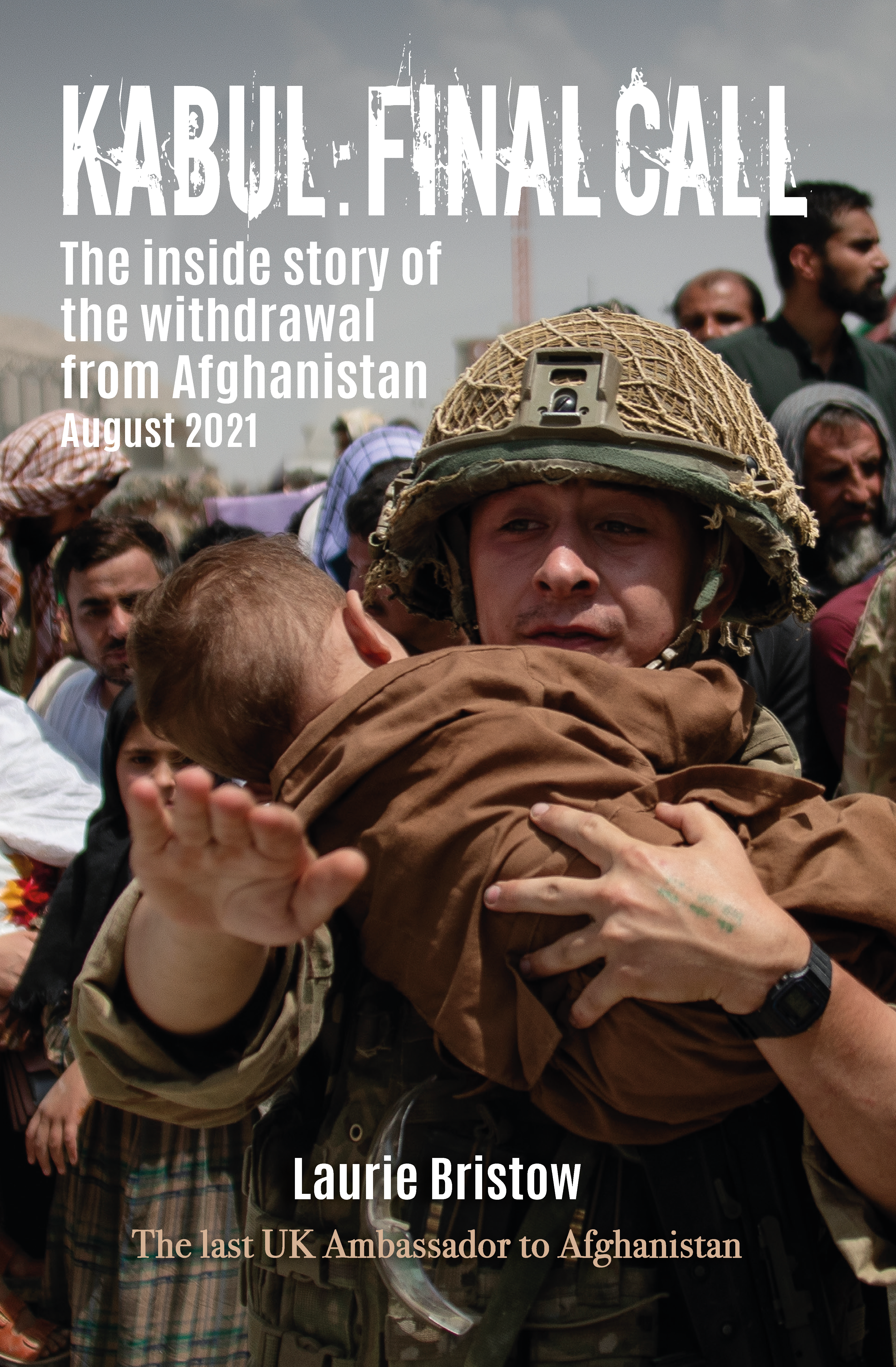
“… extraordinary eyewitness account of an historic tragedy unfolding … a must-read for any student of history, great power politics, and politico-military relations.”
Sir Sherard Cowper-Coles, former British Ambassador to Afghanistan
… a hard and necessary read about the failure of Western interventions … and how collective complacency leads to the victory of violence, tyranny and brutality.”
Shaharzad Akbar, Director of Rawadari, an Afghan human rights organisation
“A gripping and gruelling read. … a masterclass in crisis leadership and a lesson in the skills of diplomacy.”
Sir Nick Kay, former British Ambassador to Afghanistan and NATO Senior Civilian Representative
I set off for Kabul on 13 June 2021. An overnight flight changing in Dubai, then a three-hour hop across the Gulf, Iran and Pakistan, before descending over majestic mountains and desert into Kabul. I travelled light. The first rule of such postings is: do not take anything you are not prepared to leave behind. You might have to leave in a hurry.
We headed into the centre of town, the drivers weaving deftly through Kabul’s anarchic traffic, always keeping moving, eyes everywhere. Both the driver and the close protection officer had assault rifles tucked beside their seats.
A modest brass plate by the residence door bore the royal crest, and announced: ‘Residence of HBM Ambassador to Afghanistan’.
In the flat was an armoured refuge into which the close protection team hustled me during security lockdowns. If the alert was particularly serious one of them would sit with me in case we needed to extract from the building. It is a bit like sitting in a wardrobe, with a heavily armed young man or woman, radios and adrenalin crackling, the occasional bead of sweat running down your neck.
Also on 14 June we passed our hard deadline for a decision on whether the embassy could stay open after the NATO withdrawal or would have to close. This deadline felt like a significant moment: a moment when you realise that you are crossing a threshold and there is no going back.
In this fast-moving and increasingly dangerous situation, who was setting the agenda? Who had leverage over whom?
15 June 2021
For any ambassador a key part of the job is to keep in close touch with your political masters back home. You need to understand what London needs from the embassy and make sure London gets it. And also to make sure that London knows what is actually happening on the ground, and that the objectives set by London are grounded in reality.
You also have to get to know the people who take the big decisions in the country to which you have been sent, and the people who influence them. You have to earn their trust, and you have to learn how far to trust what they tell you. Building that trust can take years. It was clear that I was not going to have years. More like weeks.
It is not all about high politics and grand strategy. A big part of the job is about your responsibilities to the people working for you. Especially when working in a war zone, where the lives of your staff are at risk
16 June 2021
My first meeting with a senior government official took place within two days of my arrival. Still in COVID quarantine, I dialled into a video conference between President Ghani’s National Security Adviser Hamidullah Mohib, and a group of ambassadors from the major donor countries.
I made a point which became a central theme in my meetings with senior Afghan politicians over the weeks that followed. The republic’s leaders needed to explain to ordinary Afghans in very clear and compelling terms what was at stake for them – why it mattered deeply to them that the Taliban should not fight their way back to power.
20 June 2021
The Taliban were blocking Afghanistan’s road network and progressively isolating regional capitals. The government’s response was ineffective. There was an alarming lack of grip or cohesion within the republic.
Men who had not been paid or resupplied, in many cases for months, saw no reason to fight and die for a republic whose leaders evidently had little regard for them and no strategy worth dying for, and whose foreign allies were making for the door.
21 June 2021
I presented credentials to President Ghani. It is an ancient ritual, but still central to what an ambassador is and does. The letter of credence is handed over in person to the Head of State. Diplomacy depends on personal contact, as much personal trust as you can build with the people you are dealing with, and good judgment – both to read the intentions of your host government, and to get across those of your own government in the most convincing way.
Having such a channel is no less necessary between governments that dislike and distrust each other than between friends and allies.
27 June 2021
I asked my staff to set up calls on the ambassadors of Russia, China and Iran. These countries are some of our most difficult international partners. But they have important interests, and play significant roles in the region. I wanted to get under the skin of how their thinking was developing.
We also needed to watch for any sign that these countries might take actions that damaged our interests. Diplomacy is not only about talking with people who like you or agree with you. More often it is either about finding ways forward with people who neither like you nor agree with you – or about finding ways to block them from causing you harm.
2 July 2021
Overnight on 1-2 July US forces pulled out from Bagram airbase. Bagram, a Soviet-era airbase about 50 km north of Kabul, had been the linchpin of US and NATO operations throughout the 20-year campaign. … The news broke as the USA was going into the 4 July Independence Day holiday weekend. In Washington, President Biden … was pressed by journalists about the situation in Afghanistan. ‘Are you worried that the Afghan Government might fall?’ Biden was clearly irritated by the questions, replying: ‘I want to talk about happy things, man.’
3 July 2021
The closure of Bagram changed the mood in our embassy. At the morning meeting of the senior embassy staff I asked the team to test the closure plan. Testing a contingency plan of this sort means going through it meticulously, working out what you would do in a range of scenarios. … You need to get into the right mindset, where you have crossed over from thinking about it as something you hope you will not have to do, to something you know you probably will have to do.
The aim is also to identify the plan’s weaknesses. If you do not find any, it almost certainly means you have not tested it hard enough.
As the boxer Mike Tyson said: ‘Everyone has a plan until they get punched in the mouth.’
2 August 2021
I reported to London that we were facing a new reality in Afghanistan. Unless there was a major turnaround on the battlefield, it was likely that the Taliban would soon control at least one major population centre, with maybe more to follow. If that happened the impact on the Republic’s already fragile political unity, military and public confidence would be significant. Although Kabul remained insulated from the intense fighting elsewhere in the country, this was very unlikely to last indefinitely. The Taliban were positioning to put the capital under intense pressure when they saw fit to do so
3 August 2021
I wrote to London that we should now base our planning for the summer on the assumption that the republic would lose one or more major cities in August, maybe Lashkar Gah and Kandahar, and that this was looking increasingly likely to happen within the next seven days….The republic would be unlikely to recover if it lost Kandahar, which could in turn set off a cascading crisis as the republic’s losses mounted and its ability to do anything about them evaporated.
4 August 2021
The pressure was mounting over who should be eligible for refuge in the UK. A group of UK broadcasters and newspaper editors wrote an open letter to the Prime Minister and Foreign Secretary appealing for an urgent special visa programme for Afghan journalists who had worked with British media organizations over the previous 20 years and whose lives were at risk from the Taliban. They noted the UK’s championing of media freedom, and cited the Taliban’s campaign of targeted killings of journalists.
5 August 2021
Our dilemma over whether and when to close the embassy was becoming pressing….Move too early and we would risk bringing the whole edifice down….Move too late, and we could put our people at unacceptably high risk of being killed or taken hostage by the Taliban, by ISKP or by other extremists….We just did not know what the Taliban’s plans would be when they made their attempt to take Kabul.
6 August 2021
The Taliban captured the city of Zaranj, the capital of Nimruz province, next to the Iranian border in the southwest of Afghanistan. Above all, Zaranj mattered because it was the first provincial capital to fall to the Taliban. Its fall turned out to be the beginning of the end. Over the nine days that followed, all the other provincial capitals fell as government forces collapsed.
15 August 2021
I messaged London. ‘Taliban are through the palace gate.’ Shortly afterwards, pictures appeared on social media of the Taliban gathered around Ghani’s desk in the Presidential Palace, from which he had broadcast to the nation a few hours before. Kabul had fallen. The Taliban had taken Kabul.